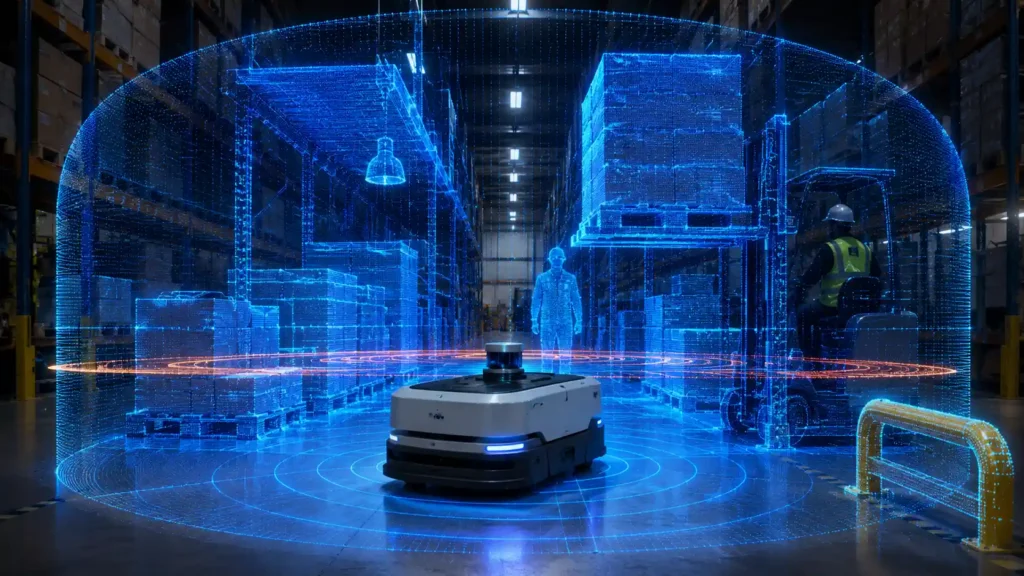
As Autonomous Mobile Robots (AMRs) become more common in warehouses, factories, agriculture, mining, and outdoor industrial environments, the need for reliable navigation and obstacle detection continues to grow. One of the most important components of an AMR navigation system is the LiDAR sensor.
For years, 2D LiDAR has been widely used for robotic navigation because of its lower cost and safety rated options. However, advances in sensor technology and falling hardware costs are driving a major shift toward 3D LiDAR. For many AMR applications, 3D LiDAR provides significant advantages in safety, environmental awareness, reliability, and autonomous functionality.
Understanding the Difference Between 2D and 3D LiDAR
A 2D LiDAR sensor scans a single horizontal plane. It measures distance across a flat slice of the environment and creates a two-dimensional map around the robot. This approach works well in controlled indoor environments with consistent flooring and predictable obstacles.
A 3D LiDAR sensor captures data across multiple vertical and horizontal angles simultaneously, generating a full three-dimensional point cloud of the environment. Instead of seeing only a single slice of the world, the robot gains a much more complete understanding of its surroundings.
This added dimensional awareness dramatically improves the robot’s ability to navigate safely and efficiently in real-world environments.
Improved Obstacle Detection
One of the biggest limitations of 2D LiDAR is that it only detects objects that intersect with the sensor’s scan plane. Obstacles that are above or below that plane may go completely undetected.
For example, a 2D LiDAR mounted at bumper height may fail to detect:
- Forks on a forklift
- Hanging obstacles
- Pallets extending above the scan plane
- Loading dock edges
- Pipes or rails
- Uneven terrain
- Low overhangs
- Curbs or drop-offs
3D LiDAR solves this problem by detecting objects at multiple heights simultaneously. This gives the AMR a much more complete understanding of the environment and significantly improves operational safety.
In dynamic industrial environments where obstacles constantly change, this additional visibility can prevent collisions, equipment damage, and downtime.
Better Navigation in Dynamic Environments
Many traditional AMR systems were designed for highly structured indoor facilities with controlled layouts. In these environments, 2D LiDAR can often provide acceptable performance, as long as the sensor does not need to detect objects outside the 2D plane or the relative size or identity of the object.
Modern AMRs are increasingly being deployed in more unstructured environments such as:
- Outdoor environments
- Construction sites
- Mines
- Agriculture
- Ports
- Manufacturing facilities
- Mixed indoor/outdoor operations
These environments are far less predictable. 3D LiDAR allows AMRs to better understand complex surroundings because the sensor captures the shape, height, and structure of objects rather than just a flat outline. This makes it easier for robots to distinguish between people, vehicles, walls, shelving, equipment, and terrain features.
The result is more reliable localization, path planning, and obstacle avoidance.
Improved Localization and Mapping
Simultaneous Localization and Mapping (SLAM) is a core capability for autonomous robots. SLAM allows a robot to build a map of its environment while determining its own position within that map.
3D LiDAR dramatically improves SLAM performance because it provides significantly more environmental data and unique reference points. Instead of relying on a limited 2D scan, the robot can identify:
- Vertical structures
- Ceiling features
- Equipment geometry
- Structural elements
- Terrain variation
This richer dataset improves positioning accuracy and reduces localization drift over time.
In large facilities or outdoor environments where GPS may be unreliable or unavailable, this can be a major advantage.
Enhanced Performance on Uneven Terrain
2D LiDAR systems are often optimized for flat warehouse floors. When the robot operates on uneven surfaces, ramps, gravel, dirt, or sloped terrain, navigation performance can degrade significantly.
3D LiDAR is far better suited for outdoor and rough-terrain applications because it can analyze elevation changes and terrain contours in real time.
This is especially valuable for:
- Agricultural robots
- Construction equipment
- Mining vehicles
- Outdoor delivery robots
- Autonomous yard trucks
- Mobile industrial equipment
As autonomous systems continue expanding into outdoor industries, 3D LiDAR is becoming increasingly important.
Reduced Dependence on Infrastructure
Many 2D LiDAR AMR systems require highly structured environments with reflectors, markers, magnetic tape, QR codes, or predefined paths.
Because 3D LiDAR provides richer environmental awareness, robots can navigate more naturally without relying as heavily on external infrastructure. This allows for:
- Greater operational flexibility
- Faster deployment
- Easier facility changes
- More scalable automation systems
This is particularly valuable in facilities where layouts change frequently or where robots must adapt to evolving workflows.
Improved Object Classification and Perception
3D LiDAR enables more advanced perception algorithms because the system can analyze object shape and volume instead of relying solely on a 2D profile.
This improves the robot’s ability to:
- Identify people
- Distinguish vehicles from stationary objects
- Detect pallet loads
- Recognize equipment
- Understand scene geometry
When paired with advanced perception software, 3D LiDAR can support sophisticated autonomous functionality including:
- Human detection
- Predictive collision avoidance
- Semantic mapping
- Intelligent routing
- Traffic analysis
- Autonomous fleet coordination
These capabilities are becoming increasingly important as AMRs move beyond simple point-to-point navigation.
Greater Safety for Human-Robot Interaction
Safety is one of the biggest drivers behind the adoption of 3D LiDAR.
Industrial facilities are busy, constantly changing environments where robots operate near people, forklifts, machinery, and inventory. A limited 2D scan plane may miss critical hazards that exist outside the sensor’s detection height.
3D LiDAR improves safety by providing:
- Multi-level obstacle detection
- Better pedestrian detection
- Improved blind spot visibility
- More accurate collision prediction
- Wider field-of-view coverage
This additional environmental awareness helps create safer autonomous systems and supports more reliable human-robot collaboration.
The Cost Gap Is Shrinking
Historically, one of the biggest reasons companies chose 2D LiDAR was cost. 3D LiDAR systems were significantly more expensive and often reserved for high-end autonomous vehicles or research applications.
That is changing rapidly.
Modern 3D LiDAR sensors are becoming:
- More affordable
- Smaller
- More rugged
- Lower power
- Easier to integrate
As costs continue to decrease, many OEMs and robotics developers are finding that the performance benefits of 3D LiDAR justify the investment — especially when considering the potential reduction in accidents, downtime, and operational limitations.
Is 2D LiDAR Still Relevant?
Despite the advantages of 3D LiDAR, 2D LiDAR still has a place in the market.
For simple indoor AMR applications, 2D LiDAR can still provide a cost-effective solution.
However, as autonomous systems become more advanced and operate in increasingly dynamic environments, 3D LiDAR is quickly becoming the preferred choice for next-generation AMR navigation systems.
The Future of AMR Navigation
The future of autonomous robotics depends heavily on environmental awareness and perception accuracy. As AMRs continue moving into more complex industrial and outdoor applications, the limitations of 2D sensing become more apparent.
3D LiDAR provides the depth perception, obstacle awareness, mapping accuracy, and safety capabilities required for advanced autonomous operation. Combined with modern perception software and powerful onboard computing, 3D LiDAR is helping enable smarter, safer, and more capable autonomous mobile robots across nearly every industry.
For companies developing next-generation AMRs, investing in 3D LiDAR technology can provide a major competitive advantage in performance, safety, and operational flexibility.
