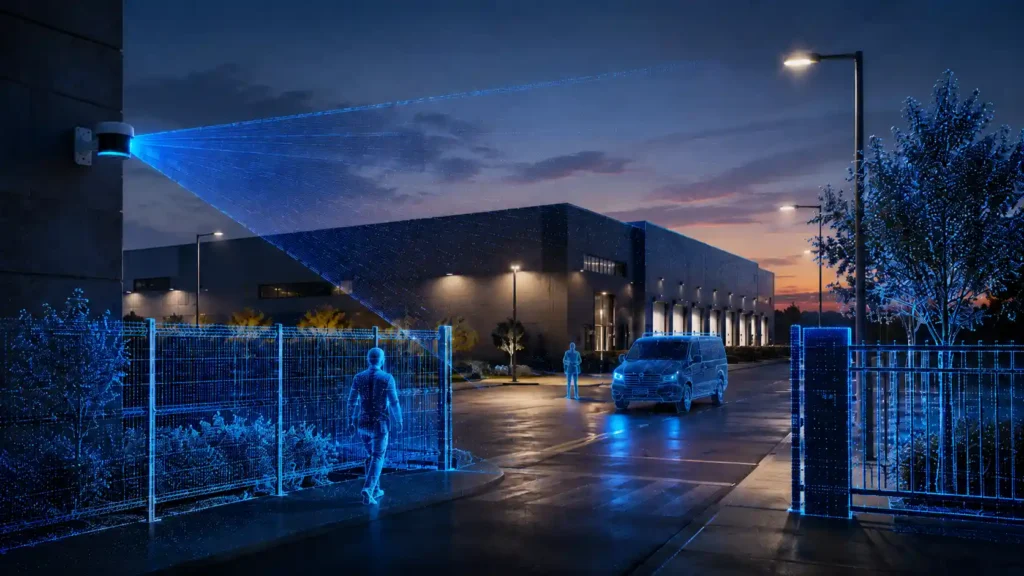
Security technology has evolved far beyond traditional cameras and motion sensors. As facilities become larger and more complex, operations become more automated, and privacy concerns continue to grow, organizations are increasingly looking for smarter and more reliable ways to monitor people, assets, and infrastructure.
LiDAR technology is emerging as a powerful solution for modern security applications because it provides highly accurate 3D environmental awareness while overcoming many of the limitations associated with traditional camera-based systems.
From industrial facilities and transportation hubs to warehouses, data centers, critical infrastructure, and public venues, LiDAR is enabling a new generation of intelligent security systems.
What Is LiDAR?
LiDAR (Light Detection and Ranging) uses laser pulses to measure distances and create highly accurate 3D maps of an environment. Instead of capturing color images like a camera, LiDAR generates a point cloud that represents the shape, size, and movement of objects in real time.
This allows security systems to detect, track, and analyze activity with exceptional accuracy while operating effectively in conditions where traditional vision systems often struggle.
Improved Detection Accuracy
One of the biggest advantages of LiDAR for security applications is its ability to provide precise spatial awareness.
Traditional cameras rely heavily on lighting conditions and image quality to identify objects and movement. Shadows, glare, darkness, weather, and visual clutter can reduce reliability and create false alarms.
LiDAR directly measures distance and object geometry, allowing it to:
- Detect intrusions more accurately
- Track movement in real time
- Identify object locations with high precision
- Monitor multiple moving objects simultaneously
- Reduce nuisance alarms caused by lighting changes or shadows
This is especially valuable in large outdoor areas or industrial environments where environmental conditions constantly change.
Longer Detection Range
LiDAR systems often provide significantly longer detection ranges than many traditional security technologies.
For perimeter security and large-area monitoring, long-range detection is critical. LiDAR can monitor large spaces such as:
- Industrial facilities
- Ports
- Airports
- Rail yards
- Data centers
- Utility infrastructure
- Distribution centers
- Parking facilities
- Campuses
Because LiDAR measures distance directly, it can maintain accurate detection performance over long distances while still providing detailed environmental information.
This allows security teams to detect potential threats earlier and respond more effectively.
Less Affected by Environmental Conditions
Environmental conditions are one of the biggest challenges for camera-based security systems.
Rain, fog, dust, glare, low light, and shadows can significantly reduce camera visibility and increase false alarms. LiDAR is generally far less affected by many of these conditions because it actively measures reflected laser signals rather than relying solely on visible light.
This makes LiDAR particularly effective for:
- Nighttime security
- Outdoor perimeter monitoring
- Industrial facilities
- Transportation infrastructure
- Construction sites
- Mining operations
- Harsh weather environments
In many applications, LiDAR can continue operating reliably even when traditional cameras experience degraded performance.
Privacy Advantages Over Cameras
One of the unique advantages of LiDAR is that it does not capture detailed visual imagery like a conventional camera system.
LiDAR typically does not perform facial recognition because it focuses on spatial and geometric data rather than detailed photographic information. In many security applications, this is actually a major benefit.
Organizations increasingly face concerns regarding:
- Privacy regulations
- Data storage requirements
- Facial recognition restrictions
- Employee privacy concerns
- Public surveillance concerns
Because LiDAR primarily detects shapes, movement, positioning, and occupancy rather than personal visual details, it can provide strong situational awareness while reducing some of the privacy concerns associated with traditional video surveillance.
For applications such as occupancy monitoring, crowd analytics, industrial safety, and perimeter security, LiDAR may offer a more privacy-friendly alternative to camera-based systems.
Highly Accurate Crowd and Occupancy Monitoring
LiDAR is extremely effective for tracking movement and occupancy in busy environments.
Unlike traditional motion sensors, LiDAR can distinguish between multiple people and objects simultaneously while accurately tracking their position and direction of movement.
This makes it useful for:
- Crowd analytics
- Public transportation monitoring
- Building occupancy tracking
- Retail analytics
- Smart buildings
- Event security
- Queue management
- Restricted area monitoring
Because LiDAR creates a 3D understanding of the environment, it can often maintain accurate tracking even in crowded or partially obstructed areas.
Reliable Operation in Low-Light Conditions
Traditional security cameras often require supplemental lighting or infrared illumination to function effectively at night.
LiDAR systems operate independently of ambient lighting conditions, allowing them to maintain strong performance in:
- Complete darkness
- Low-light facilities
- Underground environments
- Outdoor nighttime operations
This improves reliability while reducing dependence on additional lighting infrastructure.
Improved Integration with Intelligent Security Systems
Modern security systems are increasingly driven by intelligent software and automation.
LiDAR provides highly structured 3D data that integrates well with advanced perception and AI systems. This allows for sophisticated capabilities such as:
- Intrusion detection
- Autonomous threat monitoring
- Vehicle tracking
- Behavioral analysis
- Collision avoidance
- Smart access control
- Automated alerts
- Autonomous patrol robots
As AI-driven security systems continue to evolve, LiDAR is becoming an important sensor technology for improving environmental awareness and reducing false positives.
Reduced False Alarms
False alarms are a major problem in security operations because they waste time, increase operational costs, and reduce confidence in the system.
LiDAR helps reduce false alarms because it measures actual object geometry and movement rather than relying solely on pixel-based image interpretation.
This improves reliability in environments with:
- Moving shadows
- Bright sunlight
- Reflections
- Weather fluctuations
- Complex backgrounds
- Heavy traffic areas
For many facilities, reducing nuisance alarms can significantly improve overall security effectiveness.
LiDAR and Cameras Often Work Together
Although LiDAR provides many advantages, it is important to note that LiDAR does not necessarily replace cameras entirely.
In many advanced security systems, LiDAR and cameras work together:
- LiDAR provides accurate detection, ranging, tracking, and environmental awareness
- Cameras provide visual verification and recorded imagery
This sensor fusion approach allows organizations to combine the strengths of both technologies while minimizing their individual limitations.
The Future of LiDAR in Security
As LiDAR technology becomes more affordable, compact, and capable, adoption in the security industry continues to grow.
Organizations are increasingly using LiDAR for:
- Perimeter security
- Autonomous surveillance systems
- Smart buildings
- Transportation infrastructure
- Industrial safety
- Crowd monitoring
- Privacy-conscious occupancy analytics
Its ability to provide highly accurate environmental awareness while operating reliably in difficult conditions makes LiDAR a strong fit for next-generation security systems.
For many applications, LiDAR delivers the combination of long-range detection, environmental reliability, intelligent tracking, and privacy-friendly monitoring that traditional security technologies struggle to achieve on their own.
