LiDAR for
Drone Applications
LiDAR is rapidly becoming a core sensing technology for drones operating in mapping, inspection, surveying, and autonomous flight applications. By delivering high-accuracy, real-time 3D data from the air, LiDAR enables drones to capture precise terrain models, detect obstacles, and operate safely in complex environments. Unlike camera-only payloads, LiDAR provides true depth measurement, consistent performance across lighting conditions, and reliable data capture over vegetation, reflective surfaces, and uneven terrain
Common Drone Use Cases Requiring LiDAR
LiDAR can be integrated across a wide range of unmanned aerial systems (UAS), including:
- Surveying & Mapping Drones – High-precision topographic and corridor mapping.
- Inspection Drones – Infrastructure inspection for powerlines, bridges, towers, and industrial facilities.
- Construction & Mining Drones – Site mapping, cut-and-fill analysis, and volumetric measurement.
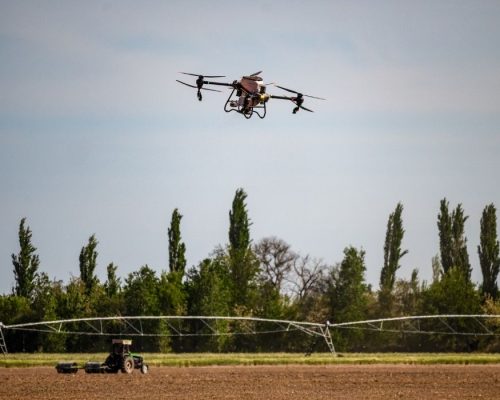
- Agriculture Drones – Terrain mapping, crop canopy analysis, and field modeling.
- Public Safety & Security Drones – Perimeter monitoring, search and rescue, and situational awareness.
- Autonomous & BVLOS Drones – Obstacle detection and navigation support for beyond-visual-line-of-sight operations.
LiDAR payloads allow drones to collect actionable spatial data while flying efficiently and safely.
LiDAR Functionality in Drone Applications
Aerial Mapping & Surveying
LiDAR-equipped drones generate dense 3D point clouds used to create digital elevation models (DEMs), digital terrain models (DTMs), and orthomosaic references. LiDAR’s ability to penetrate vegetation makes it ideal for mapping ground surfaces beneath tree canopy or dense foliage.
Volumetric Measurement
LiDAR enables accurate volumetric calculations for:
- Stockpiles and aggregate piles
- Earthworks and excavation progress
- Mining operations
- Material inventories
These measurements improve reporting accuracy and reduce the need for manual surveys.
Infrastructure Inspection
Drones using LiDAR can safely inspect bridges, railways, powerlines, towers, and industrial structures by capturing precise geometry and identifying deformation, clearance issues, or structural change over time.
Obstacle Detection & Navigation
For autonomous and semi-autonomous flight, LiDAR provides real-time obstacle detection, enabling drones to detect trees, terrain, structures, and other aircraft—critical for low-altitude or BVLOS operations.
Environmental Monitoring
LiDAR supports flood modeling, erosion analysis, forest structure assessment, and terrain change detection, offering repeatable data collection across large or inaccessible areas.
Advantages of LiDAR Over Cameras for Drone Applications
Drone environments present challenges for camera-based systems due to variable lighting, shadows, glare, and surface reflectivity.
LiDAR overcomes these limitations by offering:
True 3D Distance Measurement
Accurate elevation and object geometry rather than image-based depth estimation.
Consistent Performance in Any Lighting
Effective during dawn, dusk, or night flights.
Vegetation Penetration
Ability to capture ground elevation beneath tree canopy.
High Accuracy Over Large Areas
Centimeter-level precision for mapping and measurement tasks.
Reduced Post-Processing Ambiguity
Cleaner data sets with less reliance on photogrammetric assumptions.
As LiDAR sensors become lighter and more power-efficient, they offer superior data quality
at a cost increasingly comparable to high-end camera payloads.
Integration Considerations for Drone LiDAR
Deploying LiDAR on drones requires careful system engineering, including:
- Payload weight and power constraints
- GNSS/INS synchronization and calibration
- Vibration isolation and mounting strategy
- Data bandwidth and onboard storage
- Environmental protection and thermal management
Proper integration ensures accurate data capture and stable flight performance.
Why LiDAR Is A Key To The Future of Drone Functionality
As drone operations expand into larger areas, more complex environments, and autonomous missions, reliable perception becomes essential. LiDAR enables drones to see the world in three dimensions with unmatched accuracy, supporting safer flight, better data, and more efficient operations.
From mapping and inspection to navigation and automation, LiDAR is a foundational technology driving the next generation of aerial systems.