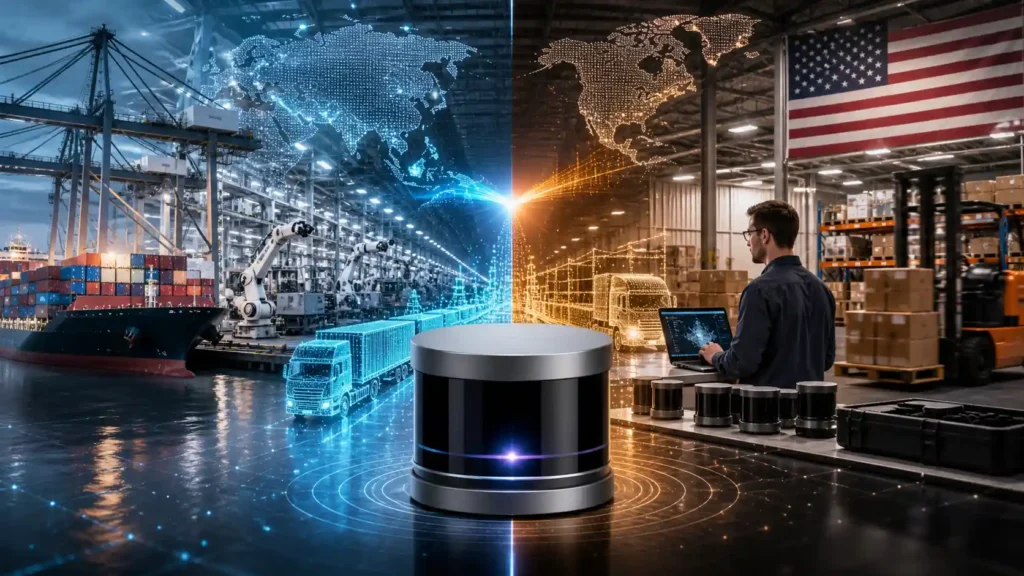
As LiDAR adoption accelerates across industries like construction, manufacturing, security, and transportation, one of the most common questions OEMs and integrators face is:
Should we source LiDAR from a foreign manufacturer or a local (U.S.-based) company?
The answer isn’t black and white. Each option comes with tradeoffs in cost, support, supply chain stability, and scalability. Below is a practical breakdown based on our experience working with numerous LiDAR manufacturers and customers across North America.
The Cost Advantage of Foreign Manufacturers
One of the biggest advantages of foreign LiDAR manufacturers, particularly those based in China, is cost.
These companies have:
- Mature supply chains
- High-volume production capabilities
- Lower labor and operational costs
As a result, LiDAR sensors from foreign manufacturers are often significantly more affordable than their U.S.-manufactured counterparts.
For many applications, especially in automation, robotics, and material handling, this cost difference can be the deciding factor in whether a LiDAR-based solution is viable at scale.
Improving Local Support from Foreign Companies
Historically, a major concern with foreign manufacturers was lack of local support. That gap is closing quickly. Companies like Seyond, RoboSense, and MicroVision now have North American offices, regional sales teams, and/or local application engineering resources to get customers faster response times and better technical support than in the past without sacrificing cost advantages of overseas manufacturing.
LiDAR manufacturers have also partnered with regional distributors like US LiDAR who can provide local support and inventory solutions.
Tariffs and Supply Chain Volatility
Tariffs remain one of the most unpredictable factors when sourcing LiDAR internationally.
Many foreign manufacturers still offer lower base pricing, even with tariffs. However, as we have seen in recent times, tariff rates can change quickly, significantly impacting landed cost and lead times can be affected by global shipping disruptions
o address this, many LiDAR companies are partnering with local distributors like US LiDAR who:
- Import and stock sensors in the U.S.
- Absorb or stabilize tariff fluctuations
- Provide faster delivery and local inventory access
This hybrid approach often gives customers the best of both worlds: lower cost with reduced risk.
The Reality of “Local” LiDAR Manufacturers
Not all “U.S.-based” LiDAR companies are as local as they claim to be.
Even when a company has a U.S. headquarters or U.S.-based manufacturing facility, their core engineering and manufacturing teams are often still overseas.
This can create challenges such as:
- Delays in technical support escalation
- Time zone gaps for collaborating troubleshooting
- Slower iteration cycles for custom solutions
For customers requiring fast support for integration or prototyping, this is an important consideration when choosing a LiDAR supplier.
Should You Buy From A LiDAR Distributor?
A common misconception in this industry is the large companies (with high volume demands) should go direct to the LiDAR manufacturers rather than working through distributors because they’ll get better pricing and direct support. In our experience working with all the major LiDAR manufacturers, that’s only partially true. The LiDAR industry is growing so rapidly that LiDAR manufacturers are often limited by the size of their sales and support teams, so they are only able to handle a certain number of customers directly before the sales team is overwhelmed. Most LiDAR manufacturers typically end up taking automotive companies and very large OEMs direct and focusing their efforts on those accounts. This can leave other customers in limbo, trying to compete for attention from sales and tech support. Reputable distributors and integrators typically have technical sales and support personnel on staff to help with troubleshooting and technical issues.
Most LiDAR manufacturers will offer customers the same pricing to work through a distributor that they would offer if the customer went direct. There are exceptions to this, but generally this is true unless the customer is purchasing thousands of sensors at heavily discounted pricing, which limits the ability of the manufacturer to provide margin for a distributor. Because of this, LiDAR distributors are often a better solution for customers of all sizes because they can provide quicker support and can also offer more customized solutions, included local inventory, custom cables, and other value added services.
Cost of US-Manufactured and BABA-Compliant LiDAR
LiDAR sensors that are manufactured or assembled in the U.S., especially those compliant with regulations like BABA (Build America, Buy America) come at a premium. It’s common to see 50% higher costs (or more) compared to foreign-manufactured sensors.
Why the higher cost?
- Domestic labor and production costs
- Compliance requirements
- Lower production volumes
- Higher equipment and warehousing costs
US made sensors are often required for Government-funded projects and infrastructure and transportation applications. For commercial applications, however, many companies opt for foreign-manufactured sensors due to significant cost savings.
Final Takeaway: It Depends on Your Application
There is no universal “best” option—only the best fit for your specific use case.
- If cost and scalability are the priority → Foreign manufacturers often win
- If compliance and domestic sourcing are required → U.S.-based options are necessary
- If support, flexibility, and speed matter → A local distributor can be the difference-maker
For many companies, the optimal strategy is a hybrid approach:
- Source cost-effective hardware globally
- Work with a local partner like US LiDAR for support, integration, and supply chain stability
If you’re evaluating LiDAR for your application and want help navigating these tradeoffs, working with a partner like US LiDAR who understands both the technology and the supply chain can significantly reduce risk and accelerate deployment.
