Solid State LiDAR Technology
Solid-State LiDAR represents the next generation of LiDAR sensing technology, offering high reliability, compact design, and cost efficiency by eliminating moving mechanical parts. Instead of using rotating mirrors or motors, solid-state systems steer or project laser beams electronically, often through MEMS mirrors, optical phased arrays (OPA), or flash illumination techniques. The result is a durable, maintenance-free sensor capable of capturing detailed 3D data with precision, making solid-state LiDAR ideal for high-volume integration in autonomous systems, robotics, and industrial equipment.
Solid State LiDAR Sensors

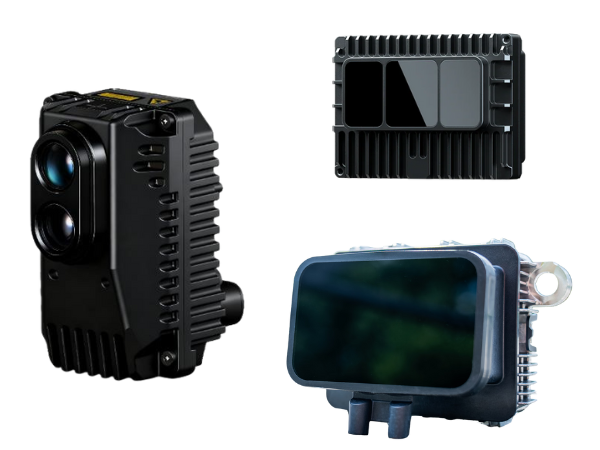
E1R is a new-generation, fully solid-state LiDAR equipped with a 120°×90° ultra-wide FOV and proprietary architecture. It combines high performance, compact design and automotive-grade reliability. Capable of real-time detection of object size, contour, and distance, E1R empowers robots to excel in obstacle avoidance, mapping, and navigation tasks.
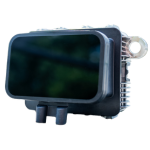
The Movia L is a pure solid-state solution with no moving parts featuring a compact, light-weight design, ensuring seamless integration into mobile units. It has a 50 G shock load and operational lifetime up to 25,000 hours. It comes with optional onboard perception software
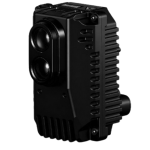
Hummingbird D1 is an automotive-grade, fully solid-state LiDAR engineered for next-generation perception. Its revolutionary electronic scanning design ensures unmatched durability and reliability for intelligent driving and robotics.
Advantages of Solid State LiDAR
- High Reliability & Long Life: With NO moving parts, solid state LiDAR is resistant to vibration, shock, and wear, providing years of reliable operation in demanding environments
- Compact & Lightweight: The solid-state design allows for smaller form factors, making it easier to integrate into vehicles, robots, and fixed installations where space is limited.
- Lower Cost At Scale: Electronic beam steering and simplified manufacturing enable lower production costs compared to mechanical systems, especially for large-scale deployments
- Low Power Consumption: Scanning a defined zone instead of 360° reduces power draw and thermal load.
- Faster Scan Rates: Solid-state systems can deliver high frame rates and real-time 3D point clouds without the latency or drift associated with mechanical rotation.
Disadvantages of Solid State LiDAR
- Limited Field of View: A restricted field of view means a single sensor cannot provide full situational awareness without additional sensors.
- Less Suitable for Mapping: Because it only captures data in a fixed direction and the point cloud density is lower, solid stateLiDAR is not ideal for mobile mapping or surveying applications that require complete 3D coverage.
- Lower Point Density: Some low-cost solid-state units trade off angular resolution for price or size.
- Shorter Max Range: Depending on design, solid-state systems may have reduced range compared to high-power mechanical LiDARs.
Applications of Solid State LiDAR
Solid State LiDAR excels in applications that demand precision and focus rather than full-environment awareness:
Autonomous Navigation
Forward-facing sensors for obstacle detection, lane guidance, and motion planning.
Collision Avoidance
Focused detection zones for forklifts, AMRs, and industrial vehicles.
Intelligent Transportation Systems (ITS)
Traffic monitoring, pedestrian detection, and vehicle counting from fixed roadside units.
Security & Access Control
Directional perimeter scanning to detect entry into restricted areas or along specific corridors.
Industrial Automation
Machine safety and area monitoring in robotic cells, conveyors, or production lines.
Infrastructure Monitoring
Detecting structural movement or alignment in tunnels, bridges, and rail systems.
Solid State vs. Mechanical and Directional LiDAR
| Feature | Directional LiDAR | Mechanical LiDAR | Solid-State / Hybrid LiDAR |
|---|---|---|---|
| Field of View | Limited (e.g., 30°–120°) | 360° | 60°–120° |
| Coverage | Focused | Full Surround | Targeted |
| Moving Parts | Typically None | Yes | No (or minimal in hybrid) |
| Integration | Compact, easy to embed | Larger and heavier | Compact |
| Cost | Moderate | Higher | Decreasing rapidly |
| Ideal Use Case | Collision avoidance, forward sensing | Mapping, survey, full navigation | Automotive and industrial perception |
Solid State vs. Mechanical LiDAR
While mechanical LiDARs provide 360° awareness through spinning assemblies, solid state LiDARs focus on specific regions of interest, making them better suited for targeted sensing where size, cost, and efficiency are priorities.
Directional vs. Solid-State LiDAR
Directional LiDAR and solid-state LiDAR share many design traits (compact, durable, and free of moving parts) but directional systems emphasize fixed scanning geometry, while solid-state sensors often use MEMS or phased arrays to electronically steer the beam.
Where Solid State LiDAR Fits In The Market
As LiDAR becomes central to autonomy, safety, and industrial automation, solid-state technology stands out for its blend of performance, reliability, and scalability. By offering accurate, real-time 3D perception in a rugged, low-maintenance form, solid-state LiDAR makes advanced sensing affordable for mainstream adoption. Whether deployed on autonomous vehicles, robotic platforms, or construction equipment, solid-state LiDAR provides the precision and dependability required to power the future of intelligent machines.